The Other Horizon
I wrote this poem about the moment where I realized I was now operating from thriving as a baseline, rather than survival mode (which had long been my M.O.).
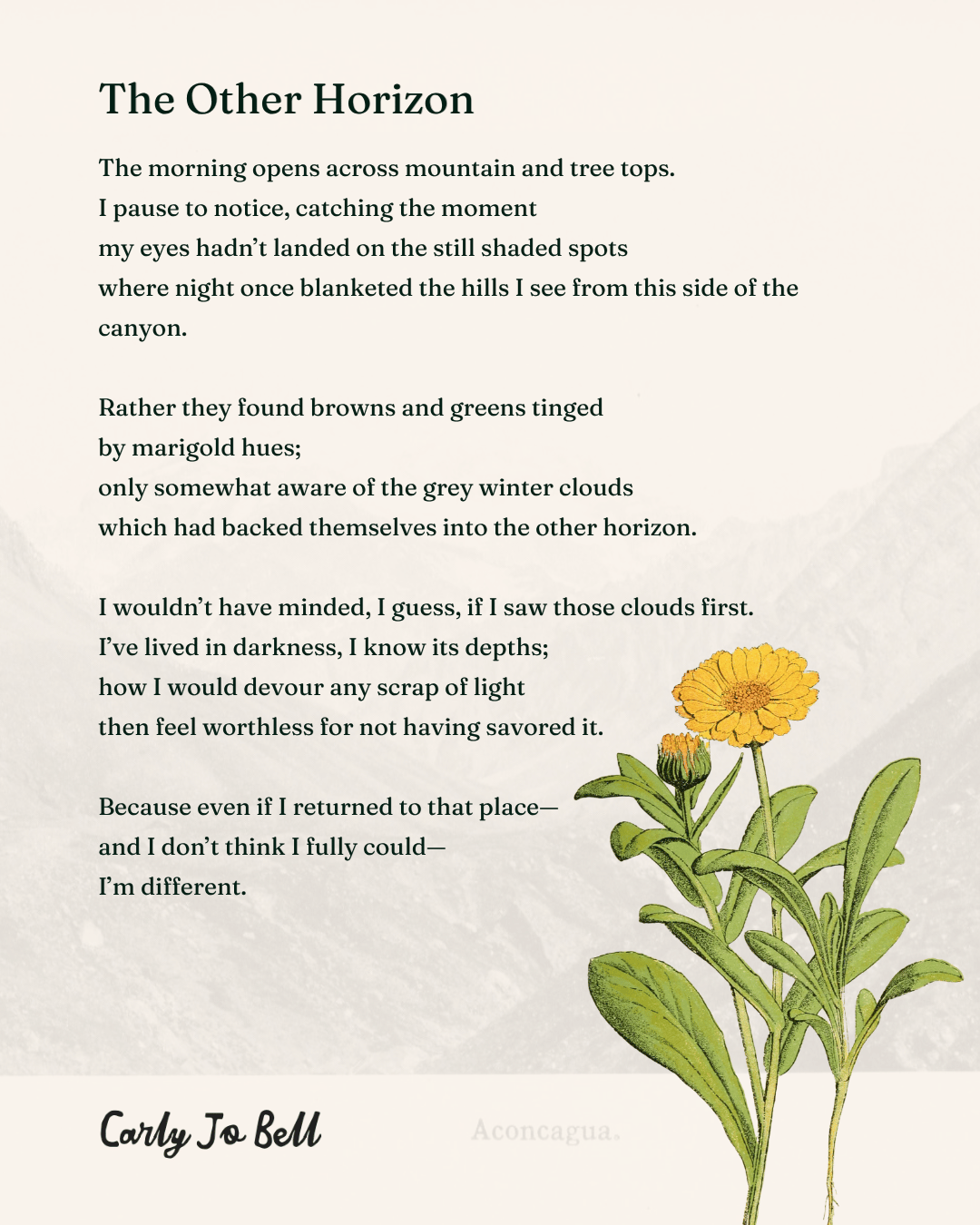
The Other Horizon
The morning opens across mountain and tree tops.
I pause to notice, catching the moment
my eyes hadn’t landed on the still shaded spots
where night once blanketed the hills I see from this side of the canyon.
Rather they found browns and greens tinged
by marigold hues;
only somewhat aware of the grey winter clouds
which had backed themselves into the other horizon.
I wouldn’t have minded, I guess, if I saw those clouds first.
I’ve lived in darkness, I know its depths;
how I would devour any scrap of light
then feel worthless for not having savored it.
Because even if I returned to that place—
and I don’t think I fully could—
I’m different.
First Draft — 11nov25
I knew I was free
When it was darkness I looked in on
Rather than being immersed within
When I radiated outward
Rather than devouring the light
When the first thing I noticed
Was how the morning flickered across mountain and tree tops
Rather than how wholly the night had settled in
Writing Notes
A friend recently introduced me to the song Antonia by Motion City Soundtrack. The song is clearly about someone the singer loves, except they never outright say that. Instead, the entire song is full of deeply specific details about Antonia, such as, “She shaves her legs with Ginsu knives.”
Such a specific detail tells us a lot about the singer; in fact, what anyone notices—and doesn’t notice—tells us a lot about them. What does it mean that the singer is paying such close attention to Antonia that they know the brand of knife she uses to shave? Well, in the context of the rest of the song, we’ll likely all infer that it means: the singer loves Antonia. Now, instead of hearing that broad truth, we understand and know for ourselves that it is true because the singer took us on that journey to that conclusion with them.
When I edited this poem, my primary focus was on moving away from broad, sweeping statements (e.g. “I knew I was free”) and toward specificity. A statement like “I knew I was free” sounds nice in theory, but it gives us no indication about the quality or context of that freedom, let alone what the author's experience of that freedom was. Whereas specificity—especially via detail-rich imagery—brings you, the reader, into the feeling the author is describing, creating space for you both to commune with one another, even just for one moment.
You know that the Motion City Soundtrack singer loves Antonia because you can see the singer paying deep attention to her. You know that I, the author of this poem, feel free because my gaze now naturally rests on the morning sunlight rather than the heavy winter clouds. And, hopefully, you are also now inspired to notice how your gaze has shifted in your life as you've grown and become more of the human you are today.
This, I think, is the power of sharing poetry. It creates space for people of varying backgrounds, beliefs, experiences, desires, etc. to stand near enough together that—for even just a brief moment—they know one another. They may not know everything about the other person, but they know this experience which is being shared through the poem. This shared experience, in turn, creates a deeper sense of belonging for both author and reader—and, ideally, both will walk away changed in whatever 'big' or 'small' way as a result.A friend recently introduced me to the song Antonia by Motion City Soundtrack. The song is clearly about someone the singer loves, except they never outright say that. Instead, the entire song is full of deeply specific details about Antonia, such as, “She shaves her legs with Ginsu knives.”
Such a specific detail tells us a lot about the singer; in fact, what anyone notices—and doesn’t notice—tells us a lot about them. What does it mean that the singer is paying such close attention to Antonia that they know the brand of knife she uses to shave? Well, in the context of the rest of the song, we’ll likely all infer that it means: the singer loves Antonia. Now, instead of hearing that broad truth, we understand and know for ourselves that it is true because the singer took us on that journey to that conclusion with them.
When I edited this poem, my primary focus was on moving away from broad, sweeping statements (e.g. “I knew I was free”) and toward specificity. A statement like “I knew I was free” sounds nice in theory, but it gives us no indication about the quality or context of that freedom, let alone what the author's experience of that freedom was. Whereas specificity—especially via detail-rich imagery—brings you, the reader, into the feeling the author is describing, creating space for you both to commune with one another, even just for one moment.
You know that the Motion City Soundtrack singer loves Antonia because you can see the singer paying deep attention to her. You know that I, the author of this poem, feel free because my gaze now naturally rests on the morning sunlight rather than the heavy winter clouds. And, hopefully, you are also now inspired to notice how your gaze has shifted in your life as you've grown and become more of the human you are today.
This, I think, is the power of sharing poetry. It creates space for people of varying backgrounds, beliefs, experiences, desires, etc. to stand near enough together that—for even just a brief moment—they know one another. They may not know everything about the other person, but they know this experience which is being shared through the poem. This shared experience, in turn, creates a deeper sense of belonging for both author and reader—and, ideally, both will walk away changed in whatever 'big' or 'small' way as a result.
Some things I particularly like in this poem:
Night “blanketing” the hills speaks to darkness not as something scary, but something caring, comforting, and protective. Which is true of the physiological experience of survival mode: our bodies go into survival mode to protect us, not to harm us.
The image of “browns and greens”—very earth-bound, steady colors—being tinged with “marigold hues,” which are shades of yellow, orange, red/pink, and white—the colors of sunshine and stars…”heavenly,” transitional colors. I used this contrast to show how you need both in order to thrive; life can’t be sunrises and sunsets all the time, but it also does need them to be complete.
The specific image of a marigold: I’m from Southern California where Mexican culture is very ingrained in day-to-day life. Marigolds are the flower of Día de los Muertos; their scent is intended to help your ancestors find their way back to you. Marigolds are also used to offer protection: both physically, as in a garden where they ward off several types of bugs that will eat your plants, as well as spiritually. Thinking about these meanings within the context of this poem, I love the image of the thing about me that’s different than it used to be being protected, perhaps by spirits or ancestors “on the other side.”
The neutrality of not minding whether I had “seen those clouds first,” signaling that I have built real self-acceptance—rather than my previous harsh criticism or judgement—of my past self who operated from that survival mode.
Probably my favorite lines: “how I would devour any scrap of light / then feel worthless for not having savored it.” → that combination of desperation for something good but then self-loathing for using it “improperly”…phew! I know it all too well.