Seven Sevens
I wrote this poem about the loss of childhood sacredness and safety, which—in my real life experience—began when my family lost our home and any other valuable assets in the 2008 recession. At which point we literally moved “to the house that faced north,” and—for many reasons, including and beyond the financial ones—went through an extremely tough period as a family that seems to have permanently altered our connections with one another.
Seven Sevens
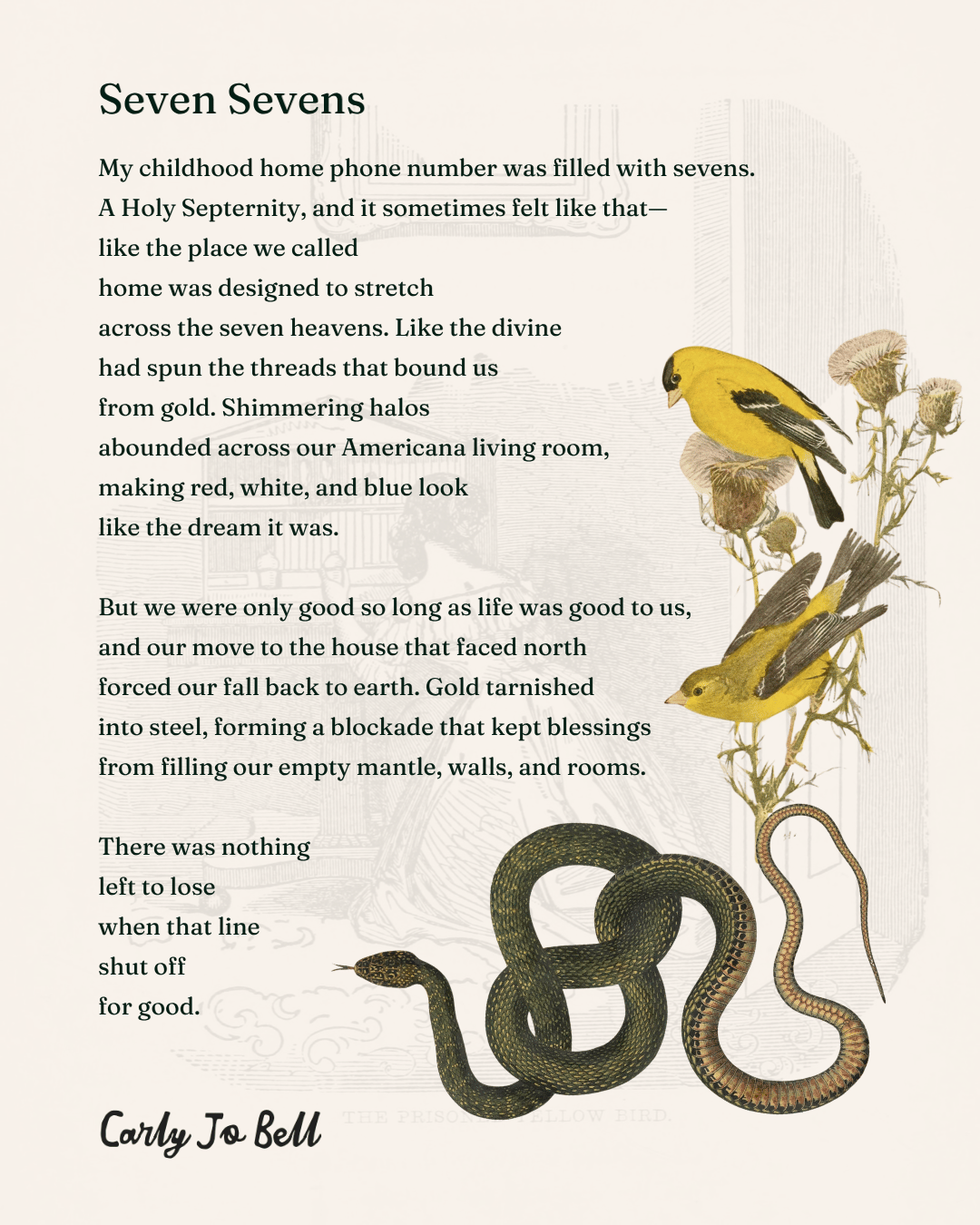
My childhood home phone number was filled with sevens.
A Holy Septernity, and it sometimes felt like that—
like the place we called
home was designed to stretch
across the seven heavens. Like the divine
had spun the threads that bound us
from gold. Shimmering halos
abounded across our Americana living room,
making red, white, and blue look
like the dream it was.
But we were only good so long as life was good to us,
and our move to the house that faced north
forced our fall back to earth. Gold tarnished
into steel, forming a blockade that kept blessings
from filling our empty mantle, walls, and rooms.
There was nothing
left to lose
when that line
shut off
for good.
First Draft — 4jun26
My childhood home phone number was filled with sevens
A holy octernity and it sometimes felt like that
Like the divine had made the threads that bound us shimmer
Golden halos abounded in our Americana living room
But we were only good so long as life was good to us
And when we moved to the house that faced north we lost our light
Benedictions no longer invaded our front room
Our sinew split for individual use
Writing Notes
I am a bit of a Goldilocks when it comes to poetry. On one hand, I get frustrated when I read a poem and it feels like I must have an MFA (masters of fine arts) to understand it. (I’m more of an MBA—masters of business—person, un/fortunately.) On the other, I get frustrated when a poem just says what it’s trying to say without taking me along for any sort of journey. (I love the quote attributed to da Vinci which says: “Painting is poetry that is seen rather than felt, and poetry is painting that is felt rather than seen.” Poets: give me a word painting, please!!!!)
Which is why, by the time I was probably ~5 drafts away from final draft, I really didn’t like this poem. I mean, I liked it, but I was frustrated with it. It was doing exactly what I wanted it to do and saying exactly what I was working to say, but it all just felt really complex, layered, and almost too much. (Or, as my fairer-haired cousin would say, “This is too hot.”)
That is, until I realized that—in this instance anyway (and this might change some of my relationship to MFA-style poetry)—this poem needed density in order to be honest. It needed to have layers and layers of myth held within it, because it was, in fact, about watching layers and layers of myth collapse. To name a few:
The myth of having a “perfect family”
The myth of white supremacy (to be clear: white supremacy is real, its core belief system is a myth)
The myth of American exceptionalism and the American dream
…and of course, where so many of these myths intertwine, the myriad of myths involved in white American Christianity
Growing up, my [white] family—(I’d like to think) largely unconsciously—built our entire world around us being perfect and thus deserving of having everything we wanted. Both of which are myths of white supremacy—the myth of perfection, and of the right to comfort—and which are also deeply and ironically intertwined with many of the teachings you hear in a white Christian church like I grew up in.
Which meant that when we discovered we were subject to all of life as every human is—in our case, by losing our house and other key material belongings—well…the very foundation of the mythical world we had built for ourselves came crumbling down. It wasn’t just losing a home, it was losing an identity, because every single part of our identity as a family and as individuals within that family was wrapped up in myth after myth after myth after myth.
Thus, this poem: myth after myth after myth after myth.
The myth of the divinely appointed phone number, of the Holy Trinity Septernity, of the seven heavens, of the Fates, of Theseus and the Minotaur, of America…myth myth myth myth myth. All in stanza one. So many freaking myths, some of which were invented for this poem and others which have been alive in humanity for millennia. There’s even the myth of the Devil’s fall—which comes from Dante’s Inferno, by the way, not the Bible—but that’s in stanza two.
And allllll of those myths crumbled at the volta of the poem: “But we were only good so long as life was good to us”. Our house in the seven heavens fell to earth, the gold that bound us turned out to be plated and the steel wore through, the blessings from our Americana living room turned out to be a mirage. All of it crumbled so entirely that we reach stanza three: “There was nothing / left to lose / when that line / shut off / for good.”
(BTW — my family literally had an Americana-themed living room when we were at our happiest. I love when my past gives me such natural images to work with.)
Some things I really like about this poem (plus some practical notes):
Seven as a proxy for the divine. The phone number was almost seen as “proof” that we were one with the divine…until reality came crashing through.
I sort of made up the word “septernity” (though I’ve seen some arguments online for it being a real word; Merriam Webster just hasn’t said so yet). I used it to allude to the concept of the Holy Trinity—as in, the phone number as a singular being made of seven distinct, individual numbers—except it needed to speak to the “seven” of it all. So, “sept” instead of “tri.”
I went with “seven heavens” because…I needed seven. But also because the concept of seven heavens is a myth in and of itself, which has permeated/guided all sorts of religions and belief systems for generations.
Our home being “designed” to stretch across the seven heavens, showcasing our belief that not only were we blessed, but we were fundamentally sacred to the point of nothing being able to touch us. (Sike!)
I also love how the poem takes us from “home” to “house.” At its simplest, that could even be one interpretation of the poem: how ‘home’ can turn into just another house because of what happens within those four walls.
I had an image of gold-plated jewelry in my head while editing/reworking this. Specifically, how gold-plated jewelry looks like the real thing until it’s worn several times and, after a couple years, it tarnishes into what it really is (not gold, but some base metal underneath it). I think waking up from a childhood reverie and naive interpretation of one's family and identity is a lot like that. Originally, this line even said “like the divine had plated the threads that bound us with gold,” but I liked allowing the fact of the threads being plated rather than solid gold be revealed later on in the poem. Plus, little kid Carly Jo—who was the one living through stanza one—believed it was solid gold. Oh, the naivete of “it looks like gold, so therefore it is gold.”
“...mantles, walls, and rooms.” Mantle signifying keepsakes and things you want to show off. Walls being the place which holds photos of experiences and people you love. Rooms being the literal spaces a home is made of. All empty: we no longer had things we wanted to show off, our memories were wiped of the happy experiences and loving connections, and our sense of home and belonging and place ceased to exist.
“There was nothing / left to lose / when that line / shut off / for good.”
I like the literalness of the “nothing” in the context of the previous line (“...empty mantle, walls, and rooms.”) which then turns into an experience of “nothing / left to lose” with the following line.
The “line” shutting off — a phone line (literal) but also a line to God (prayer) and a line of blessings (for which I had a visual of a water line in my head as I was writing it, since water is often associated with abundance).
I love the ambiguity of “for good.” Do I mean “for good” as in permanent, or “for good” as in “it was good this happened” or something else? Honestly, the answer is probably all of the above and more.
I think ultimately my favorite part of this poem is that it’s not angry at God, family, or even country. It’s heartbroken at the fact that the myths were indeed a myth. It’s less, you did this to me, and more, I believed you.
Also yes, I did initially miscount the sevens in the phone number. I thought it was eight (hence “octernity” in the first draft). I was so happy when I realized it actually was seven sevens, because, well, more sevens.