Pink Skin
I wrote this poem about coming to terms with how aware I was after a multi-year chronic illness flare of how much I have to lose when I feel “healthy” and “human” again.
Or, to be glib, I wrote this poem about life. Which sounds cliche until you realize that everything about life is cliche and therefore nothing about life is cliche. It’s all just one big cycle that we get to choose how to engage with—or not.
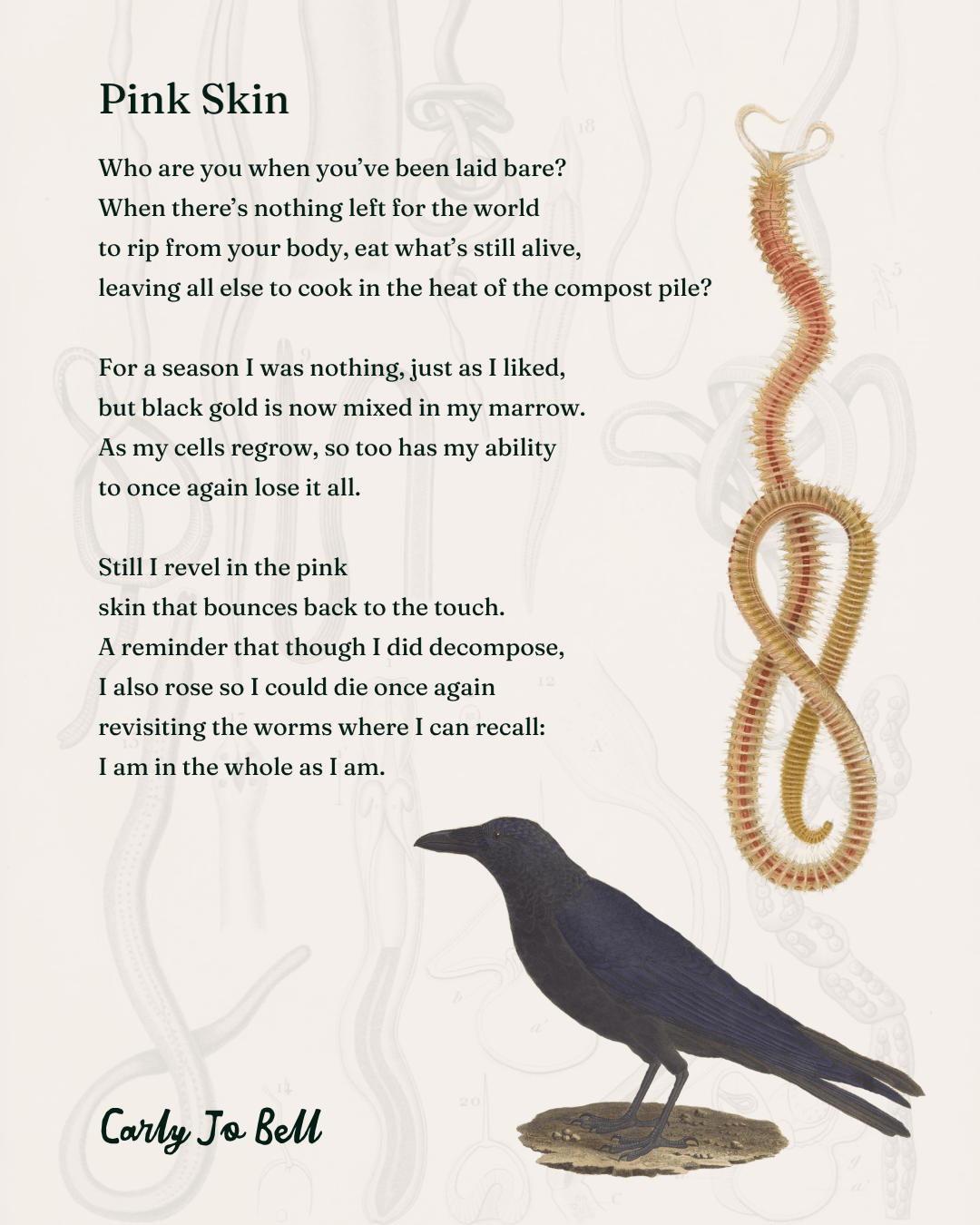
Pink Skin
Who are you when you’ve been laid bare?
When there’s nothing left for the world
to rip from your body, eat what’s still alive,
leaving all else to cook in the heat of the compost pile?
For a season I was nothing, just as I liked,
but black gold is now mixed in my marrow.
As my cells regrow, so too has my ability
to once again lose it all.
Still I revel in the pink
skin that bounces back to the touch.
A reminder that though I did decompose,
I also rose so I could die once again
revisiting the worms where I can recall:
I am in the whole as I am.
First Draft — 15apr2026
Who are you when you've been laid bare?
When theres nothing left for the world to tear?
To rip from your body and gnash in its teeth,
Added to the compost pile in its belly,
To live a new life yet still?
It's been three years of regrowing skin and organs, brain and bones
I only just realized I've been reticent to do so
For fear of having something that once again could break to leave me bare
Still I revel in the pink
Skin that bounces back to the touch
At remembering I survived that winter
I have to be alive to be able to die once more
Writing Notes
I recently read the poem Lady Lazarus by Sylvia Plath—which, (content warning) is about suicide—for the first time, and was immediately sucked in. It’s a mid-length poem, though with very short lines, so it can be read aloud in a matter of minutes. (If you do read it, I recommend you stand and read it aloud—as I did, indeed, get chills like this Reddit thread said I would.)
Now, there are certainly some white-woman-choices made in a few of the images utilized throughout. But what stopped me in my tracks about this poem was how it manages to use quite straightforward images with simple language to communicate several layers of meaning—something I strive for in my own work. You read it once and think, suicide. Read it again and find a fight against abusive power dynamics. Read it again and again and again and there’s more, more, more.
I had already written Pink Skin many months prior to my first read of Lady Lazarus, but Plath’s words made me think more deeply about my own. Where I read her poem as somewhat venerating death, Pink Skin venerates life. I see this most in my lines: “As my cells regrow, so too has my ability / to once again lose it all. / Still I revel in the pink / skin that bounces back to the touch.” Whereas my interpretation of Lady Lazarus is that death is the preferred state while life is something she hasn’t yet figured out how to get out of, so she’s going to make you pay for that fact.
Additionally, both poems use the death/rebirth cycle as a way to exert and experience power. Plath’s is a sort of wild, fearsome power while mine is a reverent, almost fearful power. Where Plath’s poem ends with the fire of the speaker resurrecting—“Out of the ash / I rise with my red hair / And I eat men like air.”—mine ends in softness, with the speaker returning to the soil—“I also rose so I could die once again / revisiting the worms where I can recall: / I am in the whole as I am.” (For my Swiftie friends, if Plath’s poem is Who’s Afraid of Little Old Me? I’d say mine more has the vibes of mad woman.)
Some things I particularly like in this poem:
The body horror of becoming carrion—or, dead and rotting flesh, as in stanza 1—and using that as a metaphor for my chronic illness experience.
The acknowledgement that I liked being “nothing” during my extended chronic illness flare up. Obviously, while I was in the thick of it, it was awful. But returning to being a functioning adult again meant returning to a lot of responsibilities—including those which had piled up during my time “out of commission” and were now even heavier than they otherwise would have been had I stayed consistently healthy.
There’s something about the rhythm of these lines that I particularly like as well—especially when saying them out loud. “For a season I was nothing, just as I liked, / but black gold is now mixed in my marrow.”
I love the line break between “As my cells regrow, so too has my ability / to once again lose it all.” You read the initial line and think about an ability—which is generally a word with a positive connotation—regrowing, but then the latter line directly contrasts that positive expectation.
I am absolutely picturing puffy baby skin in these lines: “Still I revel in the pink / skin that bounces back to the touch.” And in many ways, when I regained (some of) my health and therefore independence, I felt like a baby. To be an adult with an adult brain but to feel like a baby, brand new to the world with an entirely fresh set of eyes and sensibilities was actually quite a gift—even if I wouldn’t have ever chosen the reality that led me to that place.
The fact that the phrase “once again” could be connected to the phrase right before OR right after it: “I also rose so I could die once again / revisiting the worms where I can recall:” My brain connects it to different ones each day, I guess depending on how I’m seeing the world that day.
Yes, I did want the word “whole” in the final line to be able to be heard as “hole” (as in, six feet under/dead and composting).
By the way, I got the same question from a couple of my beta readers, so I figured I’d address it here: “black gold” is what gardeners call the soil that comes from compost. That soil is very dark (“black”) and super nutrient-rich (“gold”).
Oh, and the first line was inspired by a horoscope in my Chani (astrology) app. I don’t remember now what transit it was related to (probably something to do with Pluto), but the question kept nagging at me and I had to write to it.