Piglet
I wrote this poem about a very real memory from my childhood, which is being used as a device to explore the concept of parent-to-child unconditional love. The use of the word “knew”—instead of “know”—at the end of the poem serves as my conclusion of sorts about the topic.
Piglet
My hands, face, and dinosaurs
are covered in a mud that has eaten
many of my toys
for good.
The loss is easy, for it’s always fun
to find them again when I’ve dug deep
enough. When it’s time
for dinner, my parents hose me off.
We laugh. I splutter and screech.
The mud slides off.
I'm cold, but not for long.
They wrap me in a towel—
too big—then rub their hands
up and down my arms, fast,
to warm me up.
I wish I knew enough back then
to savor the ritual: Become
a content little piglet, then
wash the mud off. Instead I’d just
bound, sopping wet, into a hug,
then prance with the dogs and preen
for the parents who I knew
would always warm me up.
First Draft — 9jun26
My hands, face, and dinosaurs
Are covered in a mud that has eaten
Many of my toys for good
It doesn’t matter
It’s always fun to find them when I’ve dug
Deep enough
When it’s time for dinner, my parents hose me off
We laugh as I splutter and screech
It’s cold, but they warm me up
There’s a vibrancy to this earthly ritual—
Get unrecognizably dirty, wash it off—
It feels sweeter than I know how to communicate
So I bound into the house with the dogs and the parents
Who always warm me up
Writing Notes
Sometimes when I write, the most important image comes to me right at the beginning and then I craft the whole poem around it. Other times, the most important image comes to me through the editing and refining process—which is exactly what happened here.
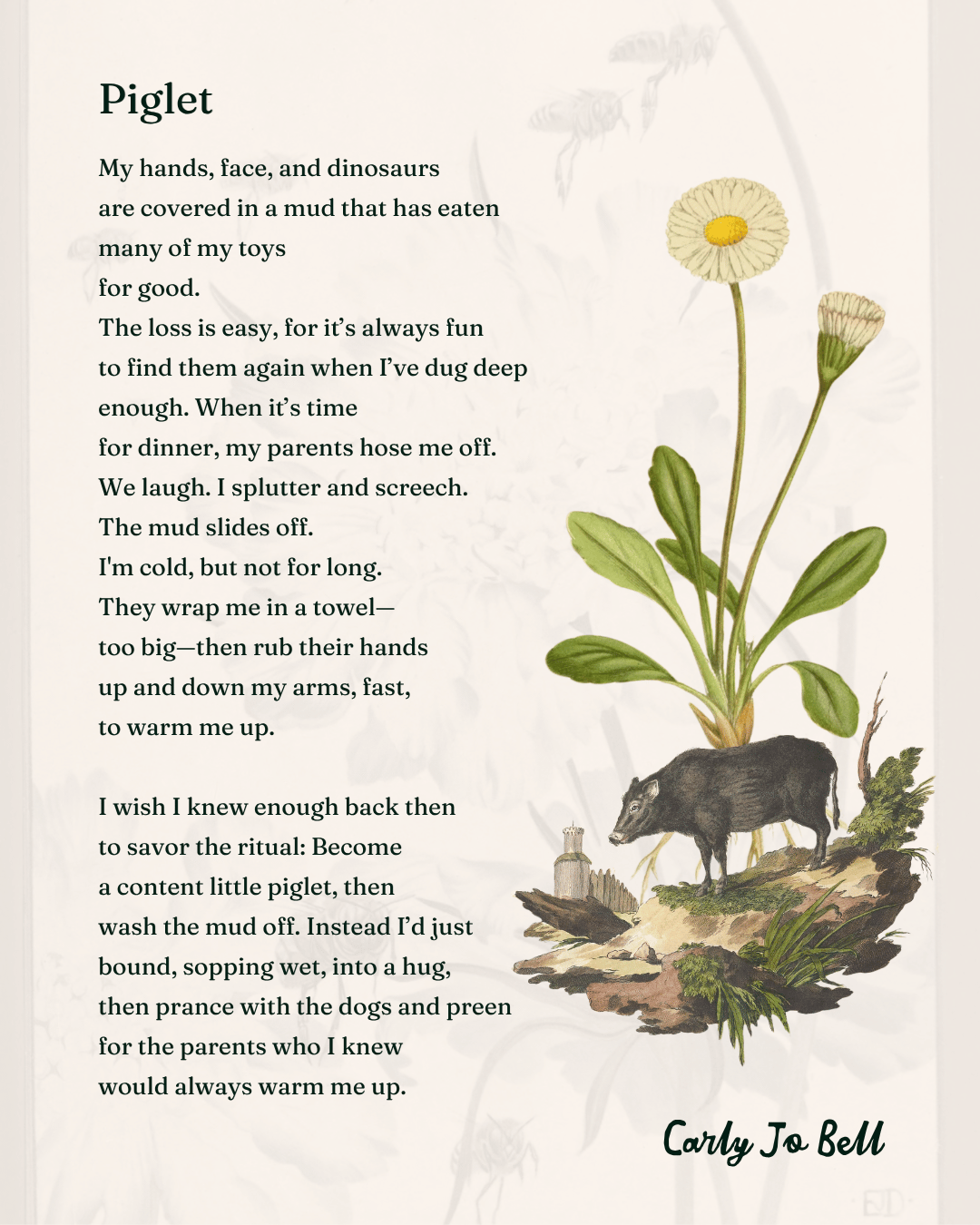
The image of the “piglet” is so important to the meaning of this poem. Pigs are allowed to exist in and with dirt. In fact—from my human perspective, anyway—they seem to relish in it. There’s no judgment on them for getting dirty, much like my parents never judged me for getting dirty. They specifically landscaped our yard to leave a patch of mud just for me to play with dinosaurs in. They created the conditions for me to be a “content little piglet.”
This image of “getting dirty” of course goes beyond the literal and into all of the ways that my parents back then offered true acceptance of all of me, even the less than “polite” parts. This is then mirrored in the image of them being willing—and not even hesitating—to give my sopping wet body a full body, tightly squeezed hug. They not only wanted all of me, they were willing to sully themselves as a result of me relishing in the experience of playing and, ultimately, of being myself.
While I see this poem as somewhat simple in concept, I think it’s an important one to have in my collection. I have a fair amount of poems that are about my difficult relationship with my family, e.g. Green Walls, I Always Wanted a Lap Cat, Twelve Year Olds Don’t Throw Tantrums. Those poems are only made stronger by the reader knowing that our familial bond used to seem quite uncomplicated and filled with genuine love and that I had space to grow into (referencing the line: “towel—too big”).
As an aside: I know why we lost that type of love, but I wonder if it’s possible not to lose it? Like, are there families out there who still have unconditional love as their throughline, well into the years of their kids becoming adults? Or does the very nature of individuation naturally create or even necessitate a bit of conditionality? (I hope it doesn’t.)
Another aside: was the love between me and my parents ever truly unconditional if, when I eventually grew out of playing dinosaurs in the mud and became more of myself as an individuated human, the fullness of their love went on to become conditional? Or was it always a prerequisite of their love that I be exactly who they wanted me to be? and as a young kid, I just hadn’t grown into myself yet?
I guess those are explorations for another poem.